
Interior Painting
How Long Does Interior Painting Take?
· By Cleiton Melquiades da Silva
One of the first questions homeowners ask before booking a paint job is a simple one: how long will this actually take? The honest answer is that it depends on the size of the space, the condition of the walls, and how many hands are on the job. A single bedroom can be wrapped in a day, while a full home repaint runs across several days.
This guide walks through realistic timelines room by room, breaks down each stage of the work, and explains what tends to slow a project down. If you are planning interior painting anywhere in Massachusetts, Connecticut, New Hampshire, or Maine, knowing the timeline up front helps you plan around your family, your furniture, and your schedule.
Typical Interior Painting Timelines
Every home is different, so treat these as working ranges rather than fixed promises. A single average-sized room (walls only, in good shape) usually takes about one day. Add ceilings, trim, doors, and closets and that same room can stretch into a second day.
A few rooms, say three or four connected spaces on one floor, typically run two to four days. That accounts for prep, drying between coats, and detail work on trim and edges.
A whole-home interior repaint is the biggest job. For most homes that means roughly five to ten days, sometimes longer if there are many rooms, high ceilings, or heavy repairs. Homes that are empty during the work tend to move faster than occupied ones, because crews are not painting around furniture and daily life.
These ranges assume standard conditions. Old plaster, water damage, or a lot of color changes can push any of them out, which we cover below.
The Stages of a Paint Job and How Long Each Takes
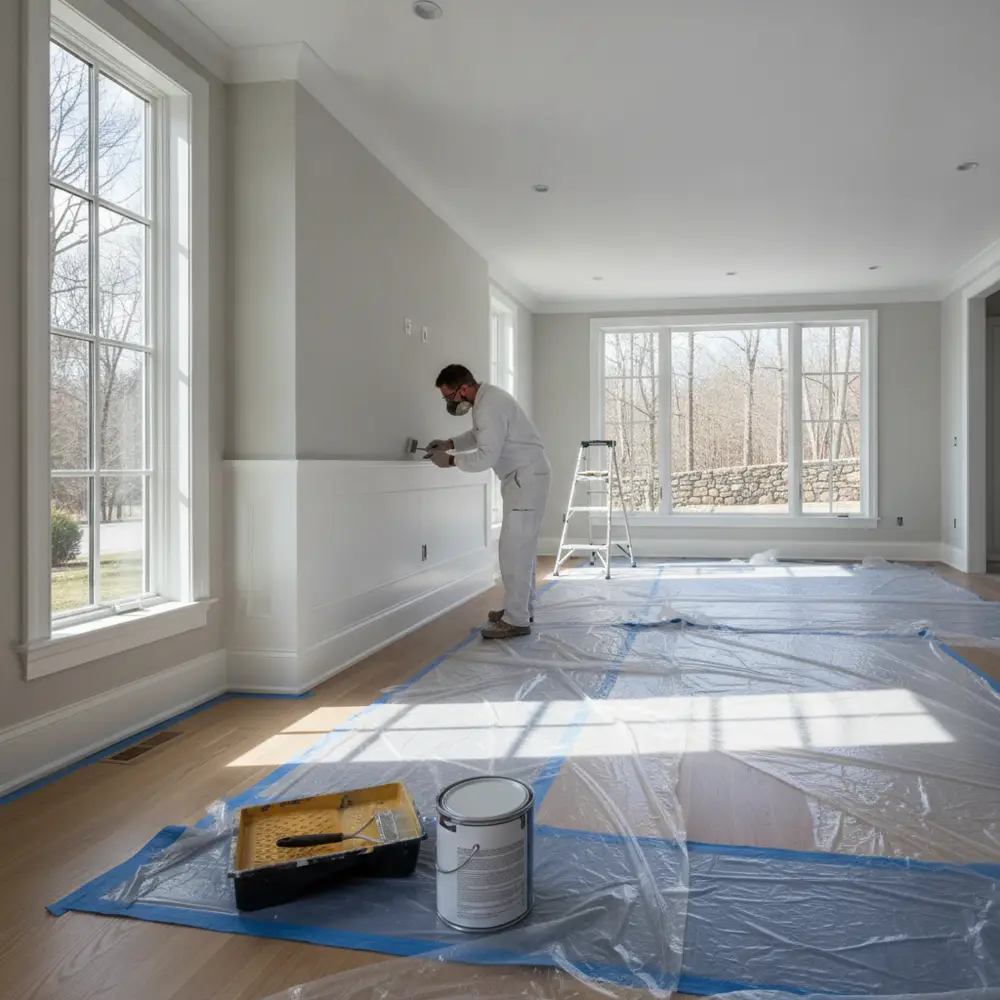
A quality paint job is mostly about the steps you do not see once the room is finished. Prep is the biggest time investment: moving and covering furniture, protecting floors, filling nail holes and cracks, sanding, caulking gaps, and taping edges. Prep alone can take anywhere from an hour on a simple room to most of a day on a room that needs repairs.
Priming comes next when it is needed, over patches, bare drywall, stains, or a big color change. Priming a room is quick, often under an hour, but it has to dry before the color goes on.
The first coat of color is the visible part everyone pictures. Rolling and cutting in a single room usually takes a couple of hours depending on size and detail.
Dry time between coats is where patience pays off. Most modern interior paints need roughly two to four hours before a second coat, longer in humid or cold conditions.
The second coat delivers the even, finished look and takes about as long as the first. Cleanup and reassembly, removing tape, cleaning tools, and putting the room back together, closes out the day. Rushing any single stage is the fastest way to end up with a finish that needs redoing.
What Slows an Interior Paint Job Down
Wall repairs are the most common reason a room takes longer than expected. Cracked plaster, water stains, holes, or peeling paint all have to be fixed, sanded, and sometimes primed before a drop of color goes on. Older Massachusetts and New England homes often have plaster that needs extra attention.
Dark-to-light color changes add coats. Covering a deep navy or charcoal with a soft white can take an extra coat or two, and each coat carries its own dry time.
Detailed trim, crown molding, wainscoting, built-ins, and multi-panel doors are slow by nature because they are cut by hand and often need a steadier, more careful pass than open wall.
Weather and humidity matter more than people expect. High humidity and cool temperatures stretch dry times, which pushes the whole schedule out. A job that flies in dry conditions can slow noticeably on a damp week.
How Crew Size Changes the Schedule
The number of painters on site has a direct effect on how many calendar days a project runs. A single painter working alone will finish a whole-home repaint far slower than a coordinated crew tackling different rooms at once.
With more painters, one can prep and repair the next room while another rolls the current one and a third handles trim and detail. That overlap is where multi-day jobs get shorter.
There is a limit, though. Dry time between coats does not shrink no matter how many people are on the job, so a small room does not go faster just by adding hands. Crew size helps most on larger homes with many separate spaces.
The right approach is matching the crew to the scope, enough painters to keep every stage moving without people standing around waiting for paint to dry.
How to Keep Your Project Moving
A few things on your end can shave real time off the schedule. Clearing rooms ahead of the crew is the biggest one. When furniture, wall hangings, and breakables are already moved or grouped in the center, painters spend their time painting instead of shuffling your belongings.
Make your color and finish decisions early. Choosing sheens (flat, eggshell, satin, semi-gloss) and final colors before the crew arrives avoids mid-job pauses while samples are compared on the wall.
Point out repairs and problem spots up front. Flagging a water stain, a soft patch of plaster, or a wall that has been patched before lets the crew plan the right prep instead of discovering it halfway through.
Plan around pets and daily routines. Deciding in advance which rooms stay accessible and where pets will be keeps the crew productive and everyone comfortable.
How Papito Inc Schedules and Keeps Your Home Clean
Papito Inc is a family-owned contractor serving Massachusetts, Connecticut, New Hampshire, and Maine with more than seven years of interior painting experience. Every project starts with a free estimate and a walkthrough, so you get a realistic timeline for your specific rooms before any work begins.
We plan the sequence room by room, prep and repair first, then prime, then color, so each stage has the dry time it needs and the job stays on track. You always know which rooms are being worked on and when.
Protecting your home is part of the job, not an afterthought. Floors get covered, furniture is protected, edges are masked, and we clean up at the end of each day rather than leaving a mess to live around.
We are fully insured and back our work with a satisfaction guarantee. To get a timeline and free estimate for your project, call Papito Inc at 781-498-8099.
Frequently asked questions
- How long should paint dry between coats?
- Most interior paints need about two to four hours of dry time before a second coat. Humidity, cool temperatures, and heavier paints extend that window, so on a damp or cold day it is smart to allow more time rather than rushing the next coat.
- Can you paint one room in a day?
- Yes, an average-sized room with walls in good condition can usually be prepped, primed where needed, and given two coats in a single day. Adding ceilings, detailed trim, wall repairs, or a dark-to-light color change can push it into a second day.
- Do I need to leave the house while it is painted?
- For most interior painting you do not need to leave. Modern low-odor and low-VOC paints let you stay in the home, and crews work room by room so unpainted spaces stay usable. Some homeowners prefer to be away during a full-home repaint simply for comfort and to speed the work.
- Why does prep take so long?
- Prep is where the finish is made or lost. Filling holes, patching cracks, sanding, caulking gaps, taping edges, and protecting floors and furniture all take real time. Skipping prep leads to peeling, visible patches, and paint that fails early, so the time spent up front pays off in a finish that lasts.
- How far ahead should I book interior painting?
- Booking one to three weeks ahead is a good target, especially in busy spring and fall seasons. Reaching out early gives you a walkthrough, a firm timeline, and your preferred start date. For urgent projects, call and ask about the current schedule.
- What is included in the painting time?
- A quoted timeline covers the full job: moving and protecting furniture, wall repairs and prep, priming where needed, two coats of paint with dry time between, trim and detail work, cleanup, and putting each room back together. It is the complete start-to-finish schedule, not just the hours spent rolling paint.
Related services
Serving
Found this helpful? Make Papito Inc a preferred source on Google.